

You Already Know This Pattern
You walk into the executive meeting with a simple question. How much are we actually spending on AI across the company, and what are we getting back? The room goes quiet for a moment longer than it should. Marketing has its tools. Operations has a different stack. Finance is running a pilot no one upstairs has seen. IT has a list, but the list is months out of date. Someone says we should "get a handle on this," and the conversation moves on.
You leave that meeting with the same uneasy feeling you had walking in. AI is happening everywhere inside the company. It is also somehow not happening anywhere that adds up.
You have seen it before, in transformation programs that stalled, in strategic initiatives that dissolved into negotiation, in operating model redesigns that never made it past the slide deck. A clear strategic direction at the top. Activity across the organization. And a growing gap between the intent and the outcome that no one can quite locate or assign.
AI adoption inside most organizations in 2026 is exhibiting exactly this pattern. The AI activity inside organizations has scaled faster than their ability to govern it, and the gap is widening every quarter.
This is not a technology problem. It is the strategy execution gap, it is the result of an operating model that was never redesigned for this particular strategic change, the same structural gap that causes 67% of well-formulated strategies to fail, expressed through the technology that is currently consuming the most leadership attention.
The structural cause is the same as it always is: the operating model has not been designed to absorb what has been decided. Decision authority is undefined or distributed by default. Governance cadence is inherited from the wrong era. Workflows are being touched by AI tools without anyone asking whether the workflow itself should be redesigned. And the capital process is quietly favoring efficiency proposals over the ones that would actually change position.
What This Canvas Is
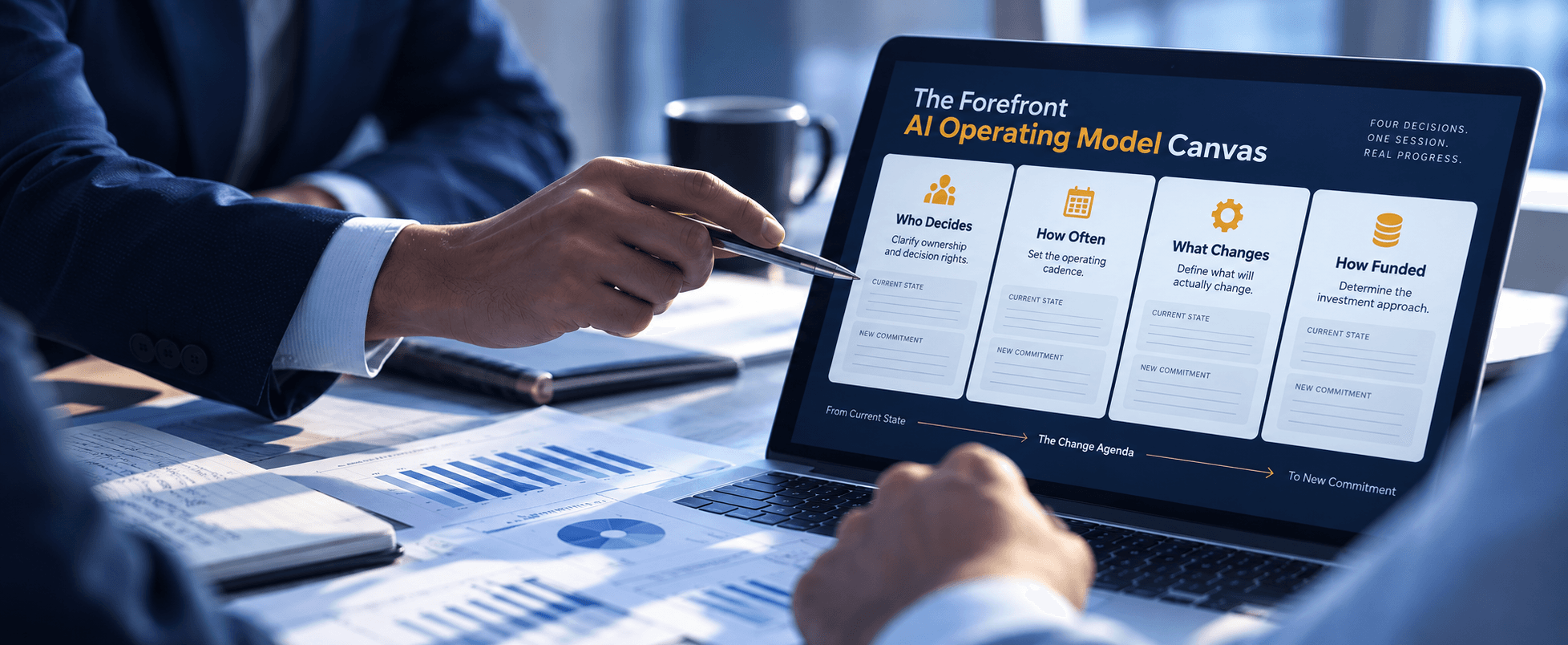
The AI Operating Model Canvas is a single page. It forces a leadership team, in one working session, to make four decisions they have probably been avoiding without realizing they were avoiding them.
These four decisions are the same four structural choices that determine whether any strategic initiative survives contact with the operating model. In our strategy deployment work, they are the choices that separate organizations where strategy compounds from organizations where strategy drifts. Applied to AI, they are:
- Who actually decides what AI work the company commits to. Not who appears on the org chart. Who, by name, has the authority to say yes or no before money is spent.
- How often we look at what is happening across the AI portfolio. Not the rhythm inherited from traditional IT governance, the rhythm that matches how fast AI is actually moving inside the company.
- What we are willing to redesign, and just as importantly, what we are explicitly choosing not to touch. Because every workflow we leave alone is a workflow where AI will produce a faster version of the same thing, not a different thing.
- How we fund it, and whether the way we approve AI spend is quietly favoring the proposals that change nothing strategic over the proposals that would.
The canvas does not assess. It commits. The output is not a score. It is four decisions, with four names attached, with four review dates, written down in front of the people who will be held to them.

Why This Will Feel Different From Other Frameworks
Most AI frameworks start with AI, maturity levels, adoption stages, technology readiness. They tell you where you are on a capability curve.
This canvas starts with the organization. It asks the same four structural questions we would ask in any strategy deployment engagement, where does authority sit, what is the governance rhythm, which processes are actually being redesigned, and how is capital being allocated, and applies them to the specific problem of AI adoption.
The argument behind why these four questions matter, and what specifically is being damaged when they go unanswered, is laid out in the companion article, When Strategy Breaks at the Operating Model: AI Adoption and the Execution Gap. Read the article if you want the full structural case. Download the canvas when you are ready to do something about it.
What You Will Actually Do With It
The canvas is completed twice in a single working session of three to four hours, with five to twelve people in the room. First pass captures what is actually true today. Second pass captures what the team is now committing to instead. The gap between the two passes is the change agenda.
Most teams that complete the canvas discover two things. First, that two or three of the four quadrants have no real owner at all, the decisions that were supposed to be made by someone are being made by whoever moves first. Second, that the governance and funding quadrants are more inherited than anyone expected, even when ownership and workflow redesign are in reasonable shape. This matches the pattern we see in strategy execution work broadly: the failures that get the most attention are not the ones doing the most structural damage.
Who This Is For
This canvas is built for the people inside an organization who can actually make these four decisions stick, typically the CEO or the executive directly below, strategy leaders, the heads of the functions where AI is most active, and whoever has been informally absorbing AI ownership without a clear mandate.
If you are the person who has been carrying the weight of "we need to do something about AI" for the last months, the canvas is the thing you bring into the next executive meeting instead of another deck.
AI Operating Model CanvasOne Page ToolFree DownloadDownload Now →The canvas is available as a one-page PDF designed for print at A2, along with a companion guide for the facilitator running the session. Both are offered freely.
Download AI Operating Model Canvas and Forefront ai canvas companion guide
The canvas reflects how Forefront approaches any operating model question, governance, decision authority, resource allocation, workflow design, applied here to one of the most visible strategy execution challenges of 2026.